
Newly identified protein could mitigate oreliminate excessive scarring during woundhealing
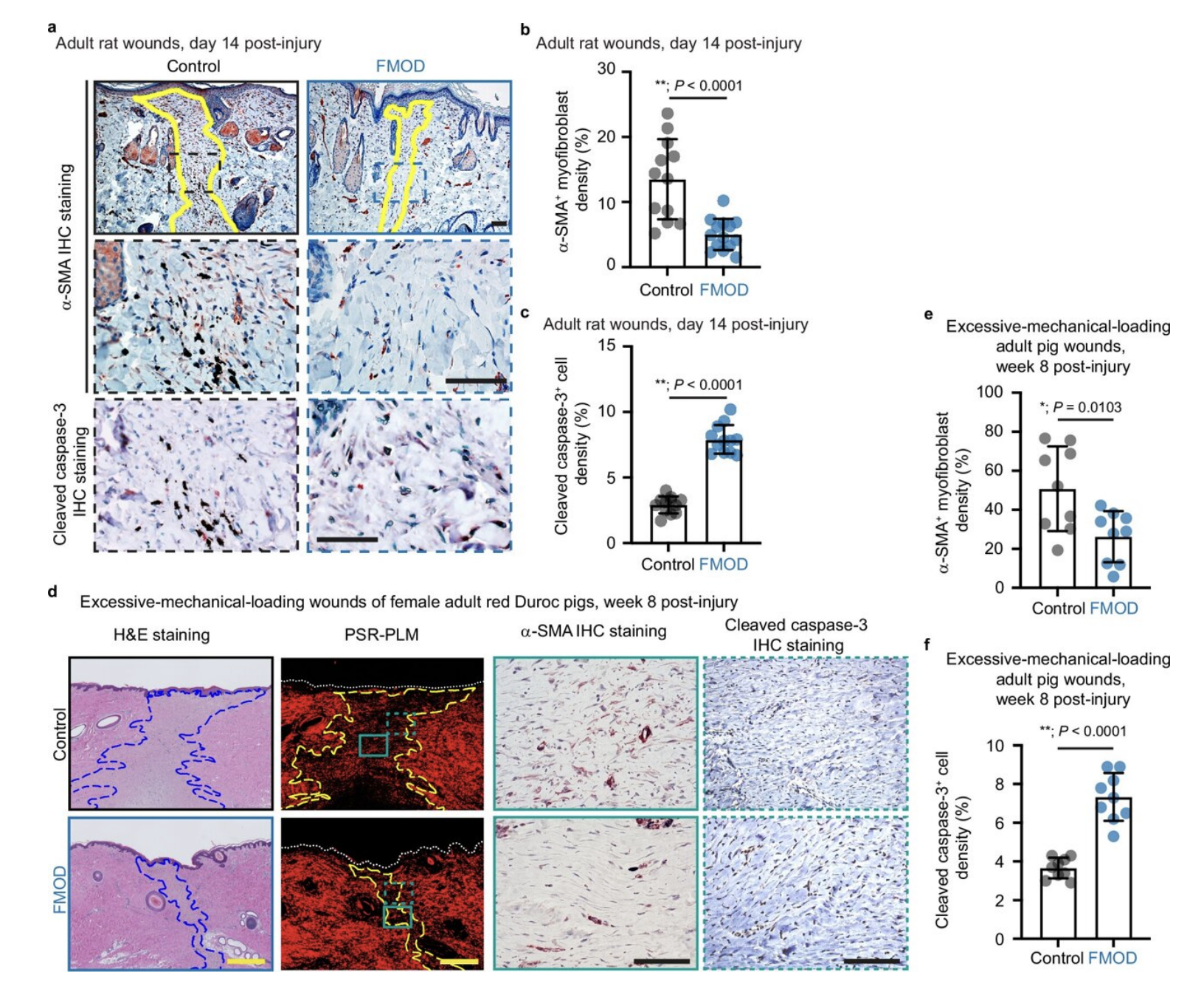
Fibromodulin (FMOD) accelerates myofibroblast clearance in rat and pig models with reduced scar formation. Credit: Nature Communications (2025). DOI:10.1038/s41467-025-58906-z
A study published April 12 in Nature Communications identifies a protein that helps prevent excessive scarring. The protein, called fibromodulin (FMOD) forms a complex of molecules with interleukin 1β that stops myofibroblasts from forming excessive scar tissue.
The findings could lead to a new way to reduce or prevent excessive scarring, which could benefit patients recovering from surgery, injuries, or burns.
In previous studies, the researchers had described the critical role of FMOD in enabling scarless fetal-type repair as well as preventing excessive scarring during adult-type repair.
For this new study, the researchers investigated the effects of FMOD on myofibroblasts, a key cell in healing and scar formation. Myofibroblasts should die off after a wound heals, but they can continue forming tissue long afterwards, leading to excessive scarring. The fibromodulin-based complex promotes the death of myofibroblasts.
“Dr. Eric Kang Ting and I have been studying how to reduce skin scarring for the past two decades at UCLA,” said Dr. Chia Soo, professor of surgery and vice chair for research for the UCLA Division of Plastic and Reconstructive Surgery.“
This publication explores the crucial role of naturally occurring fibromodulin in regulating a key scar-forming cell, the myofibroblast. This, combined with our team’s FDA-approved clinical study led by Dr. Zhong Zheng using a fibromodulin-derived peptide in 54 patients for scar reduction, demonstrates a significant leap in potential treatments for patients with excessive scarring.”
Study co-authors are :Wenlu Jiang, Xiaoxiao Pang, Pin Ha, Chenshuang Li, Grace Xinlian Chang, Yuxin Zhang, and Lawrence A. Bossong, Eric Kang Ting, and Zhong Zheng.
More information: Wenlu Jiang et al, Fibromodulin selectively accelerates myofibroblast apoptosis in cutaneous wounds by enhancing interleukin 1β signaling, Nature Communications (2025).DOI: 10.1038/s41467-025-58906-z
Provided by University of California, Los Angeles
Citation: Newly identified protein could mitigate or eliminate excessive scarring during wound healing (2025, May 6) retrieved 29 January 2026 from https://medicalxpress.com/news/2025-05-newly-protein-mitigate-excessive-scarring.html